
The herd scanning results below are taken from detailed Fertility Focus reports for Vetora Waikato dairy farms. These reports use the number of cows present at Planned Start of Mating (PSM) rather than cows present on the day of scanning. Results also exclude split‑calving herds and herds scanned too late for accurate pregnancy ageing.
For these reasons, not every farm will be represented in the summary data.
Table 1. 2025/26 reproductive performance KPIs for Vetora Waikato dairy herds

Across our client base, there is a significant range in reproductive performance, reflecting the many factors that influence herd fertility from season to season. Interestingly, both the lowest and highest empty rates were observed after approximately 70 days (10 weeks) of mating, highlighting the impact of mating length and early submission success.
When we compare this season’s results with last year across Vetora Waikato clinics, several clear trends emerge.
The graph below shows the change in 6‑Week In‑Calf Rate for 151 Vetora Waikato dairy herds, comparing the 2024/25 and 2025/26 seasons. Each blue dot represents an individual farm.
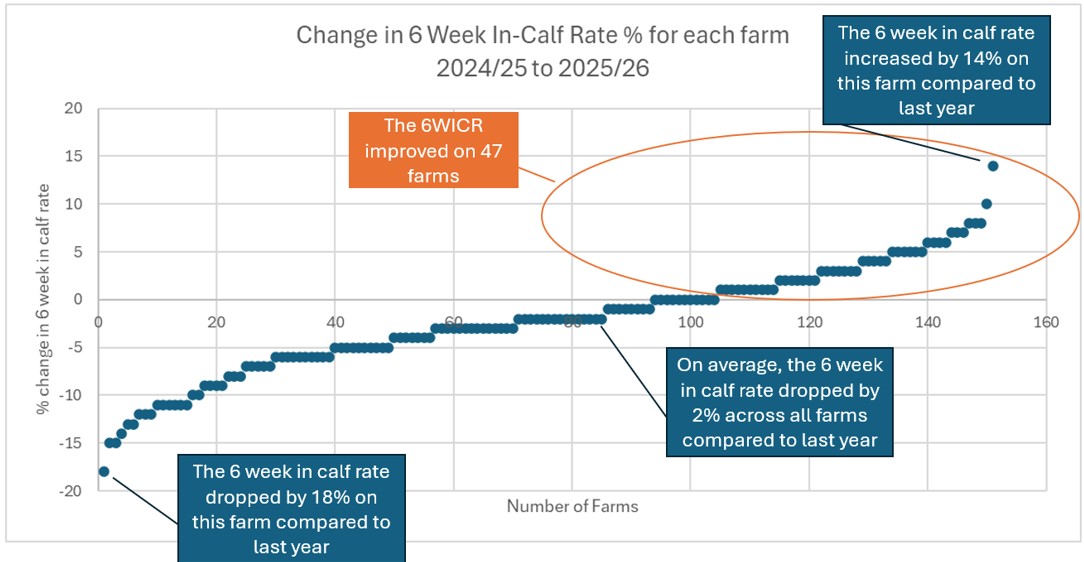
Figure 1. Percentage change in 6‑Week In‑Calf Rate for Vetora Waikato herds from 2024/25 to 2025/26.
On average, 6WICR declined by 2% compared with last season. However, this masks important positive performance:
This variation shows that even in a tougher reproductive year, management decisions still make a meaningful difference.
The second graph compares the change in empty rate (measured after up to 12 weeks of mating) across the same set of herds.
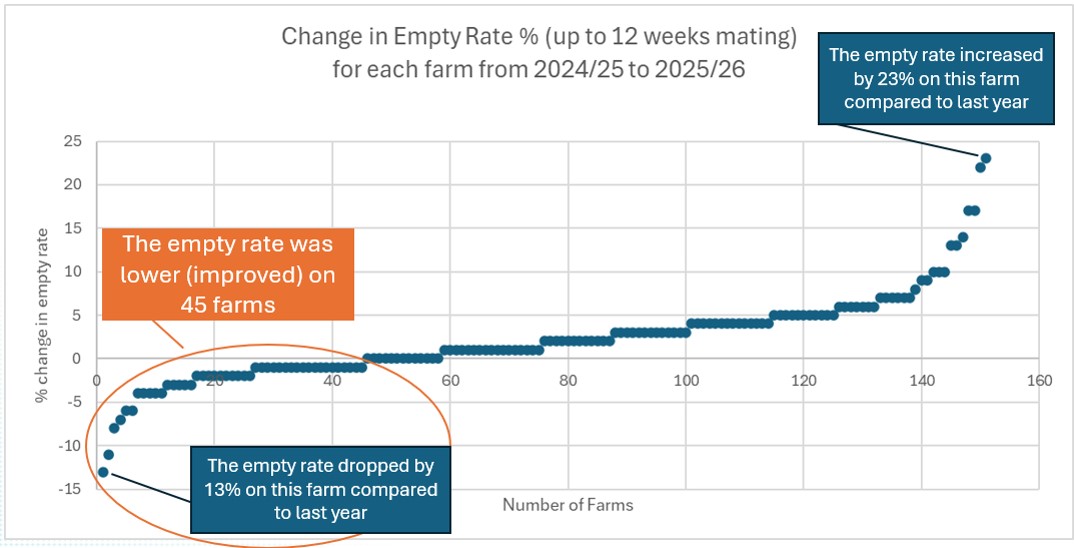
Overall, the average empty rate increased by 2% compared with last season. However:
Once again, the spread of results highlights that reproductive outcomes are highly farm‑specific.
There is no single reason for the variation seen this season. Influencing factors include:
Understanding which factors matter most on your farm is the key to improving results.
The best place to start is a reproduction consultation with your Vetora vet.
Together, we can:
If you use wearable technology, we can go even further — analysing cow activity, submission timing, and early mating performance to proactively manage reproduction next season and respond quickly if things move off track.
Strong reproductive performance doesn’t happen by chance. It is planned, monitored, and adjusted — and the earlier that work starts, the better the result.
